Safe heating in camps means a displaced family can stay warm without paying for it with choking smoke or a fire in its tent. The search for warmth pushes many families toward polluting fuels and makeshift stoves in poorly ventilated shelters, and women and children pay the highest price, according to the World Health Organization.
In brief
- Around 2.1 billion people worldwide rely on polluting fuels and technologies at home.
- In poorly ventilated dwellings, indoor smoke can carry fine particles at 100 times the acceptable level.
- Accidental ingestion of kerosene is the leading cause of childhood poisonings.
- Qatar Charity’s winter campaign aims to reach 59,665 beneficiaries with heating and energy and 52,550 with shelter.
What Threatens Safe Heating in Camps?
Heating becomes dangerous when it relies on polluting fuel inside a cramped shelter with little fresh air. According to the WHO, indoor smoke in poorly ventilated dwellings can contain fine particles at levels 100 times higher than acceptable, and a large share of severe burns and injuries in low- and middle-income countries is linked to household energy used for cooking, heating and lighting.
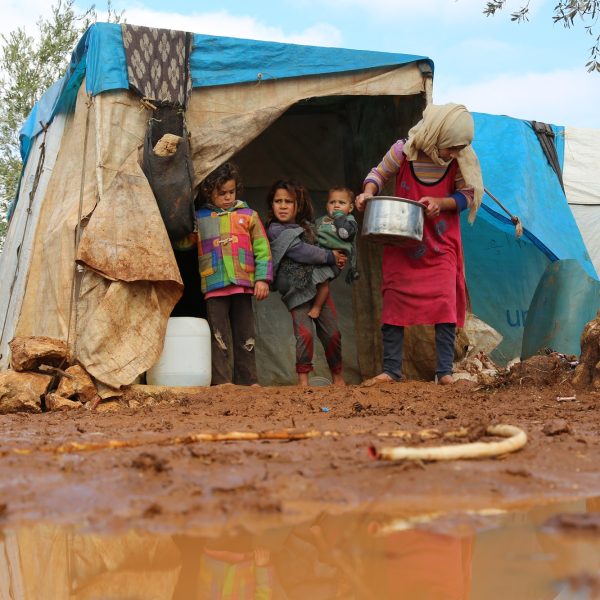
A tent is more fragile than a house: its fabric catches fire quickly, and its small space puts the stove, the bedding and the children in one place. A source of heat is not enough; it has to be safe and suited to the space.
Who Is Most Harmed by Unsafe Heating?
Women and children are most harmed, because they spend the most time near the stove indoors. The WHO notes that polluting fuels place their heaviest health burden on them, and that inhaling soot from household air pollution causes almost half of all deaths from lower respiratory infection among children under five.
Gathering fuel adds another risk: in less secure environments, women and children face injury and violence while collecting it. For more on how the cold affects young children, read How Does Cold Affect Children’s Health?.
How Can Families Achieve Safe Heating in Camps?
A family stays safer when ventilation, distance and safe storage become daily habits. These simple steps reduce smoke build-up and the risk of fire and poisoning:
- Leave a ventilation opening in the tent or shelter, especially while the stove is lit.
- Keep the stove away from tent fabric, bedding and clothes.
- Store kerosene and other fuels in closed containers out of children’s reach.
- Put out the fire before sleeping and never leave it unattended.
To prepare fully for the cold season, read How to Prepare a Displaced Family for Winter.
What Does the Winter Campaign Provide for Heating and Shelter?
Qatar Charity’s winter campaign aims to reach 59,665 beneficiaries with heating and energy and 52,550 with shelter, within a plan covering 8 countries. These interventions pair a source of warmth with a safe place to keep it:
- Bangladesh: refilling 9,533 gas cylinders to international safety standards, and building or rehabilitating 210 thermally insulated shelters in the Rohingya camps.
- Afghanistan: firewood for 1,000 families, alongside mattresses and blankets.
- Lebanon: 1,000 heating fuel vouchers and 15,000 winter blankets for refugees and host communities.
- Pakistan: 3,000 cold-resistant tents.
See the campaign country by country in Winter Campaign Outside Qatar.
How Can You Support the Search for Warmth?
You can help by supporting safe heating in camps and shelter together: every fuel voucher, safe gas cylinder or cold-resistant tent brings a family closer to a warm winter without danger. Donate to the winter campaign now.
Heating and shelter in winter: figures and questions
How many people worldwide rely on polluting fuels at home?
Around 2.1 billion people, about a quarter of the world’s population, rely on polluting fuels and technologies at home, according to the WHO.
How many deaths does household air pollution cause each year?
Household air pollution was responsible for an estimated 2.9 million deaths in 2021, including over 309,000 children under five, according to the WHO.
How many beneficiaries does Qatar Charity’s winter campaign aim to reach?
The 2026-2027 winter campaign aims to reach 532,115 beneficiaries in 8 countries, across food security, winter aid, heating and shelter, according to Qatar Charity’s campaign plan.
What is in the campaign’s winter shelter kit?
A cooking set, plastic sheeting, blankets, plastic mats and solar lamps, distributed in Sudan, Somalia, Djibouti and Kenya, according to Qatar Charity’s campaign plan.