
We saw in a previous article that it is human nature for a child to grow up between two parents and under their care, and there is a great divine wisdom in that, since the family is the natural environment with the most effective impact on shaping and developing every aspect of the child’s growth, as through the parents the child’s basic needs, whether social, psychological or emotional, are met. This is especially so for orphans, who are in the greatest need of social care and psychological support.
To know what sponsorship means in law and how to start, see the guide Orphan Sponsorship: Its Rulings and How to Begin Today.
A child who suffers severe deprivation in their early emotional life for any reason, such as the death of one or both parents, their illness or the imprisonment of one or both, always has a weak response that cannot bear the burdens and troubles of life.
Indeed, these factors leave the child permanently unable to form relationships of love with others, because of the child’s instability and readiness to face life and inability to satisfy their wishes within the family, since the feeling of deprivation results from an obstacle between the child and the satisfaction of their wishes and needs, and at the same time this feeling contains a threat to the child and their personality.
The impact of the challenges that the child faces and that limit their social upbringing
The group of children is the most exposed to suffering and harm as a result of crises, disasters, wars or hardship.
Among the crises the family, as the first nucleus of social upbringing, is exposed to are divorce and the death of the father, which affects the social care of children and leads them to isolation and withdrawal, weak communication with others, or the violation of some of their basic rights, such as deprivation of education and being forced into early work, and so on.
In addition to the above, wars and disasters lead to psychological trauma, and affect children’s well-being and their social and psychological growth through the loss of family and friends or some of them, the difficulty of living conditions, and the inability to provide financial support to families and basic services.
When the father dies the family may suffer great shocks, having lost a basic pillar that stood for warmth, care, guidance and the provision of its living needs, and the mother finds herself alone before many challenges, the most important being full responsibility for the family materially and morally.
The pressure of raising children falls on the widow
The mother is forced to carry out the task of caring for and bringing up her children and following their affairs, and perhaps to work in addition to secure a source of income for the family if she can. Any failure in these tasks, especially without a helper, leads to psychological and social imbalances whose price the mother and her children pay.
The problem may be greater if the mother abandons her family for one reason or another (though this is rare in our Arab and Islamic societies, because of marriage for example), which causes the family to break up and the children to risk going astray, being lost and being exploited.
Following from the above, there is a need to attend to the social and psychological care of orphans.
Given the challenges they face through their lives, their inability to meet their needs themselves, and the need for parties to step in or support to achieve and satisfy these needs in different forms.
Social care for orphans
Social care for orphans means the official and unofficial efforts provided to orphaned children, in fact or in law, in residential institutions or substitute families, or even if they live with their family (their mother and siblings), through sponsorship such as the sponsorship now common among Arab charitable organizations, which includes monthly financial support as well as periodic activities and events set aside for the orphan in educational, cultural, social and recreational fields.
The international community has also cared about children’s rights: the Universal Declaration of the Rights of the Child issued in 1948 stated the child’s right to care and support, and that humanity must give the child the best it has, without discrimination on grounds of sex, nationality or religion.
The child must also be placed in a position that enables normal development materially and spiritually, with food, treatment, care and shelter provided for the orphaned and homeless child, the child must be the first to receive aid in times of distress, and must be protected from all forms of exploitation and ill-treatment.
To compare the systems and models of orphan sponsorship, one must identify the child’s most important basic need, to see which models achieve it best.
Maslow’s hierarchy
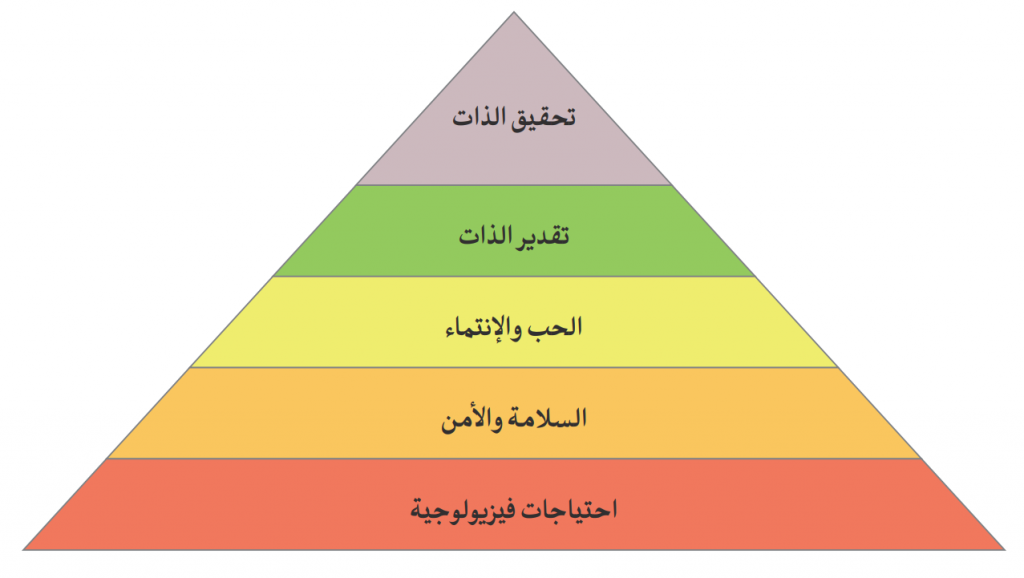
Maslow’s hierarchy of needs, set out by the American psychologist, is among the most discussed models of human needs in general, including the child, and it ascends from the bottom to the top:
In Maslow’s view, whenever a person satisfies a need they move on to seek the next one up the hierarchy. The needs should be seen as one whole, in which the higher (developmental) levels depend on meeting the lower basic needs.
However, reaching a certain level of needs does not cancel the role of the lower needs, and does not stop a person from sometimes returning to lower levels, which is normal.
The child’s social needs
The most important social needs of the child:
A – The need for social belonging
It begins from the child’s natural place in the family, and if that does not happen in an acceptable way, serious social and psychological deviations are to be expected.
B – The need to assert oneself
The child needs to assert themselves, and that happens only in a natural social setting where they feel they are part of a group that accepts them and recognizes their effort and contribution to its activities. The family is the first human group in which the child finds this need satisfied, through parents’ praise, encouragement and admiration of their work and behavior.
C – The need to play a particular social role
This is a very important need in the child’s social development: through the social setting (the family) the child feels they have a role tied to their sex, age and growth, such as a girl helping her mother with housework, and a boy helping his father at work and buying the household’s needs.
D – The need for social standing
This need is a basic pillar in the child’s life despite their young age. They feel it inwardly through relationships of rejection and acceptance, love or hatred or hostility, or through the descriptions they are given and hear from their parents. They begin trying to satisfy it from childhood until they become a grown man who wants to have standing in his family and society.
E – The need for social interaction
A child, or a person in general, cannot live without society, and through it the child absorbs the whole culture with its standards and values.
F – The need for social security and reassurance
The child needs a safe social atmosphere in which they are not exposed to physical or moral threat and danger. The family is the first place where the child satisfies this need, and if that does not happen the child may grow up with many psychological problems such as feeling persecuted and fear.
G – The need for love
The need for love is no less than the need for food and drink. The family, and the mother first of all, is the source of satisfying this need, and it develops into words and acts of approval that the child hears or feels when they grow up, especially from the family and the mother.
H – The need for social skills:
How to deal with and connect to people, such as making friends and getting things done. If the child does not learn these skills, they are likely to grow up isolated, not knowing how to behave with peers and members of society.
From here it can be said that, when a child is away from their natural environment in the family, they become an abnormal child exposed to many psychological disorders and social problems.
From this starting point, it is better for the orphan to live in a family and social atmosphere. The closer they are to the natural social environment, the healthier their growth, and the further they are from it, the opposite. So it is preferable that the orphan live with their mother and family, and if that is impossible, with one of their relatives, or in a substitute family.
Orphans’ families (mothers and orphans) must also be supported, to ensure orphans are helped to meet their social and psychological needs through sponsorships and social care programs, and educational and awareness courses set aside for orphans’ mothers on child-rearing and care, teaching them life skills.
Many sponsoring mothers come from an environment where ignorance prevails, and there is little experience or awareness in managing the family budget, which means the money intended for the orphan is often not spent satisfactorily and many opportunities are lost.
Psychological support
Orphans need psychological support, especially in crises and disasters, what is called psychological support in emergencies, to overcome difficult experiences and limit the development of psychological problems in children, and to build a sound, healthy personality that can depend on itself in the future. Support efforts include age-appropriate cultural activities and safe, stimulating activities such as sports and games to develop life skills, coping mechanisms and support for resilience.
These efforts are directed to orphaned children and their mothers, since the burden of raising their children falls on them. There are various guides to psychological support services issued by international organizations such as: “Mental Health and Psychosocial Support in Emergencies: What Should Humanitarian Health Workers Know?” – published by the World Health Organization.
From the book “Rafaqa … the Largest Family in the World” – Ghiras series no. (11) – Qatar Charity (adapted).
Read also:
- The Orphan Sponsorship Guide: Its Rulings and Steps to Begin
- Orphans Who Excelled in Their Studies
- Protecting Children and Orphans in Disasters
Frequently asked questions about psychological support
Why does an orphan need psychological support, not only spending?
Because losing a parent hits the child in their social needs, not only in their allowance: belonging, self-assertion, security and love. Spending meets the material need, while these need a stable human relationship and follow-up, which the sponsor and the organization provide together.
What are the orphan child’s main psychological needs?
The need for social belonging, self-assertion, playing a social role, standing, dealing with others, security and reassurance, love, and social skills. The absence of any of them shows up later in school performance and relationships.
How is psychological support given to orphans in crisis-hit areas?
Through child-friendly centers, trained specialists, and group activities that give the child back a sense of safety and routine. The World Health Organization recommends integrating psychological and social support into the humanitarian response from its first day, not after the situation settles.
Is the mother’s presence enough to make up for the father’s absence?
The mother’s presence is a basic protective factor, but it does not remove the need for support. The widow carries the burden of upbringing and providing together, which is a doubled pressure. That is why sponsorship programs target the whole family and not the child alone, to ease the burden on the mother and support the child at once.