

Technology and education seem an obvious pairing, but not an automatic one. A digital tool fills a gap when access to school is impossible, but it does not create learning where the teacher is absent to begin with. With 93 million children out of school in crisis areas (Education Cannot Wait, 2025), the question has become practical, not theoretical.
Technology does not replace direct support for the student, detailed in Sponsoring a Student of Knowledge: Your Complete Guide.
Technology is today among the most important factors that help improve the quality of education, and it plays a vital role in supporting learning and expanding opportunities to reach knowledge. It remains the most capable of providing innovative solutions that help strengthen education in these communities, despite the great challenges many disadvantaged communities around the world face in providing good education.
1* Providing access to education online
A report by UNICEF and the International Telecommunication Union indicates that two thirds of school-age children in the world cannot access the internet at home. In low-income countries, at most one child in 20 of school age has an internet connection at home, compared with about 9 in 10 children in high-income countries.
In many disadvantaged communities, many lack education opportunities because of a shortage of schools or the difficulty of reaching them. Here technology offers a suitable solution, as the internet can be used to deliver educational content over the network. Students can access online lessons and learn through e-learning platforms, which helps provide learning opportunities for those who live in remote areas.
2* Improving the quality of education
Technology helps improve the quality of education by offering interactive means and varied educational content. Educational software and interactive applications can be used to make the educational process more exciting and effective. Digital educational resources can also be provided that help students understand concepts better and strengthen interaction and active participation.
3* Developing technology skills
Distance learning and the use of technology in education are a means of developing students’ technology skills. These skills strengthen future job opportunities and enable young people in disadvantaged communities to adapt to the developments of the modern labor market.
4* Mobile learning
In many low-income countries, people have limited access to computers, but smartphones are widespread. These devices can be used to deliver education through mobile learning apps, which provide educational content that can be reached easily through smartphones. That means students can benefit from educational resources at any time and in any place, making learning more flexible and opportunity-rich.
5* Virtual reality and augmented reality technology
Virtual reality (VR) and augmented reality (AR) technologies open new doors for improving education in disadvantaged communities. They can be used to provide immersive and realistic learning experiences, even with limited material resources. For example, students living far from museums or historical sites can visit them virtually through virtual reality technologies, which enriches their educational experience and widens their horizons.
6* Achieving equal opportunities in education
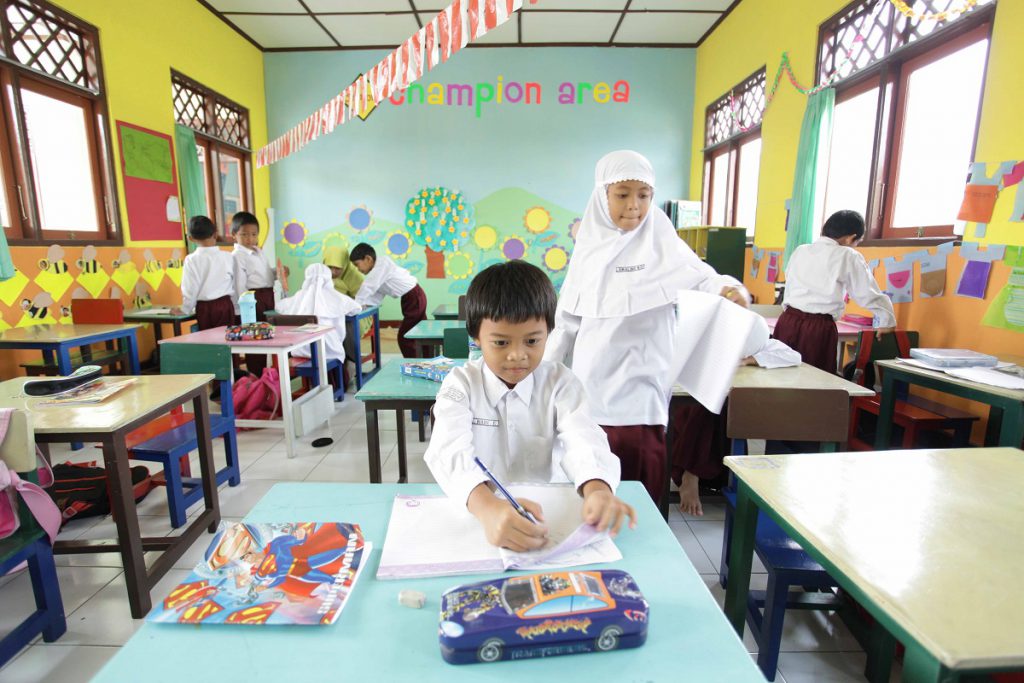
Using technology helps promote equal opportunities in education, as equal educational resources can be provided to everyone regardless of economic circumstances. Technology can help narrow the gap between students living in low-income areas and their peers in wealthier communities.
7* Strengthening uses of artificial intelligence
Artificial intelligence (AI) can play a large role in improving education in low-income countries. Here are some ways AI can contribute in this context:
A- Personalizing education to students’ needs
AI can analyze educational data effectively to understand students’ needs and provide tailored guidance. It can be used to analyze test results and student performance, letting teachers identify each student’s strengths and weaknesses individually and give the support needed.
B- Providing personalized learning experiences
AI can create educational programs designed specifically for each student’s needs. This gives learners unique and improved opportunities to understand materials and concepts better and faster.
C- Providing online educational support
AI can be part of online education platforms and educational applications, where it can provide immediate, direct support to students. For example, it can give instant answers to questions, provide individual guidance, and offer interactive exercises.

D- Empowering teachers and developing their skills
AI can also be used to support teachers, whether by analyzing class data and offering suggestions to improve the educational process, or by providing educational resources and tools tailored to develop their skills.
E- Effective educational management
AI can be used to analyze big data on the performance of schools and educational districts, enabling education officials to make better and more accurate decisions on directing resources and improving the performance of the education system.
Challenges and sustainability
With these developments, there remain challenges related to providing the infrastructure technology needs and training teachers to use it effectively. Sustainability must also be considered in integrating technology into the education system to ensure it lasts in the long term.
In conclusion
In conclusion, it can be said that technology plays a vital role in strengthening education in disadvantaged communities, helping to widen access, improve quality, strengthen technology skills and achieve equal learning opportunities. By investing in this field, a positive change can be made in the future of education and real progress achieved in communities facing hardship.
Where do the limits of technology in education lie?
At three conditions: electricity, connectivity and the teacher. Where any one is absent, the digital tool becomes a burden, not a solution. That is why the value of technology and education is not measured by the number of devices distributed, but by what changed in learning results.
The evidence is that 70 percent of ten-year-olds in low- and middle-income countries cannot read a simple text (World Bank), a gap no device closes, only a qualified teacher supported by the tool.
Frequently asked questions about technology and education
How does technology strengthen education?
By delivering content where reaching school is impossible, enabling self-learning, and supporting the teacher with ready materials. It is most useful in conflict and displacement areas where regular education stops.
Does technology replace the teacher?
No. The digital tool multiplies the effect of a qualified teacher but does not replace them. The evidence is that 70 percent of ten-year-olds in low- and middle-income countries cannot read a simple text, an education gap that devices do not close (World Bank).
What is meant by the digital divide in education?
It is the unequal access to electricity, internet and devices among students. Its effect is that interrupted schooling doubles the difference: those who have the tools keep learning, and those who do not stop completely.
How does Qatar Charity support education digitally?
By equipping schools, supporting distance learning paths in areas where access is hard, and training teachers to use these tools, so that technology supports education and does not replace it.
Every school seat saved brings a return that lasts for decades. Contribute to supporting education through Qatar Charity.